
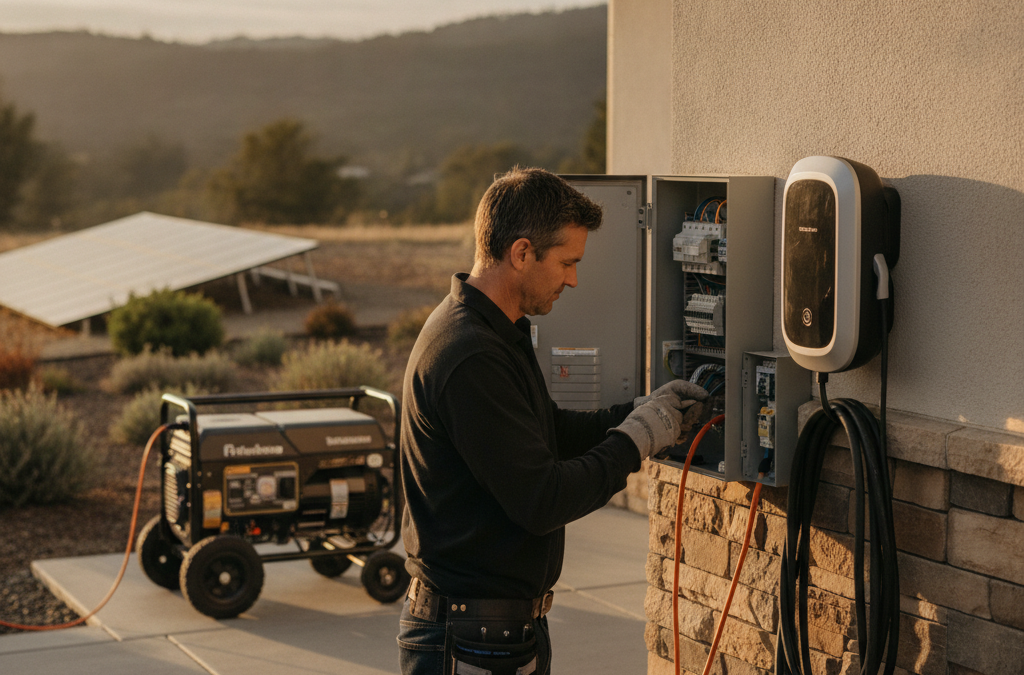
PSPS Outages in Sonoma County: Do You Actually Need a Whole-House Generator?
If you live anywhere in Sonoma County — Rohnert Park, Cotati, Penngrove, Sebastopol, or out toward the Healdsburg hills — you already know PG&E’s Public Safety Power Shutoffs aren’t a hypothetical. They happen, sometimes with a day’s notice, sometimes less. The question most homeowners ask us after the second or third outage isn’t whether to do something about it. It’s what to do — and how much they actually need to spend. The honest answer: it depends on your household, and a whole-house standby generator is often not the right starting point.
What a PSPS Outage Actually Looks Like in Practice
PG&E initiates PSPS events when wildfire risk is high — typically during the late summer and fall when offshore winds pick up and relative humidity drops. Parts of Sonoma County with overhead transmission lines in high-risk zones see these shutoffs more frequently than areas closer to the US-101 corridor with underground service. That said, even homes in Rohnert Park’s flatter neighborhoods can lose power when the transmission infrastructure feeding them is affected upstream.
Outages typically last 12 to 72 hours. That’s long enough to spoil a refrigerator, lose sleep with no CPAP machine, or leave a well pump useless. It’s also long enough to matter if you or a family member depends on medical equipment. What it usually isn’t, for most households, is a situation that requires powering your entire home as if the grid never went down.
The Three Real Options — Explained Without the Sales Pitch
1. Whole-House Standby Generator
A standby generator sits outside your home on a concrete pad, connects to your natural gas or propane line, and starts automatically within seconds of a power outage — day or night, whether you’re home or not. It powers your entire electrical panel: lights, appliances, HVAC, EV charger, everything.
This is the right solution if you work from home and can’t afford downtime, you have medical equipment that cannot lose power, you manage a rental property in Penngrove or Windsor where you won’t be on-site during an outage, or your household genuinely depends on climate control year-round. It’s a real investment — equipment, installation, permits, and the gas line work add up — and it requires annual maintenance. But if it fits your situation, it’s the most seamless option available.
Every standby generator installation we do includes a properly permitted automatic transfer switch and a final inspection. That’s not optional — it’s how the job gets done safely and legally. Learn more about standby generator installation here.
2. Critical-Loads Panel with a Portable Generator Inlet
This is the option most local electricians don’t explain well — and it’s often the best fit for the majority of Sonoma County homeowners.
A critical-loads panel (sometimes called a generator panel or emergency panel) is a small subpanel we install alongside your main panel. It contains only the circuits you actually need during an outage: the refrigerator, a few lights, the furnace blower, a phone charging outlet, and maybe the well pump or medical device circuit. We install a generator inlet — a weatherproof outdoor receptacle — that connects your portable generator to those specific circuits through a transfer switch.
The cost is significantly less than a whole-house standby system. You still need a portable generator (or may already own one), but you’re running it strategically — powering what matters, not burning fuel to run circuits you don’t need at 2 a.m. during a shutoff. And because the transfer switch is properly installed with a permit, you’re not backfeeding the grid — which is both a code violation and a genuine safety hazard for utility workers.
For families in Rohnert Park, Cotati, or Petaluma who want real outage protection without the cost of a full standby system, this is frequently the right call.
3. Battery Storage (Without a Generator)
If you already have solar or you’re considering adding it, a battery system like the Enphase IQ Battery or Franklin WH can power critical loads through a PSPS event without any fuel, noise, or exhaust. Post-NEM 3.0, the economics of solar alone have shifted — but pairing storage with an existing system or a modest new array makes real sense for Sonoma County homeowners who want quiet, automatic backup that doesn’t depend on a gas line or generator maintenance.
Battery-only backup has capacity limits — most residential systems will carry critical loads for 8 to 24 hours depending on usage. For PSPS events that extend beyond a day or two, a generator paired with batteries gives you the best of both. We handle both sides of that equation under one license, one permit process — no finger-pointing between trades. Find out more about solar and battery storage options.
What Competitors’ Sites Often Skip: The Transfer Switch Conversation
Browse most local electrical contractor websites and you’ll find generator installation listed as a service — but almost no explanation of how a generator connects to your home safely. This matters more than the generator itself.
You cannot legally or safely plug a portable generator into your home through an extension cord run to an open panel. A properly installed transfer switch or interlock kit — permitted and inspected — is what separates a safe backup power setup from a liability and a hazard. When we install your generator connection, we pull the permit, do the work correctly, and schedule the inspection. That’s not a premium add-on; it’s the baseline.
What to Ask Before You Commit to Any System
- What circuits do I actually need during an outage? Make a realistic list before you size anything.
- Do I have natural gas service, or will this require propane? Propane tanks need sizing and placement, which affects cost and timeline.
- What’s my panel’s current capacity? Some older 100-amp panels in Sonoma County’s 1960s and 70s housing stock may need an upgrade before a standby system can be added cleanly.
- Will this be permitted and inspected? If a contractor says you don’t need a permit for generator installation, walk away.
- What’s included in the written estimate? Transfer switch, inlet, subpanel, conduit, concrete pad, gas line coordination — get it all itemized before anyone starts work.
We give you a written scope and firm price before any work begins. If a critical-loads panel gets you what you need for less money than a whole-house system, that’s what we’ll tell you. We’re not here to sell you the most expensive option — we’re here to solve your actual problem.
Frequently Asked Questions
How long do PSPS outages typically last in Sonoma County?
Most events last between 12 and 48 hours, though some have extended to 72 hours or more in higher-risk areas. The unpredictability is part of what makes a system with automatic startup — either a standby generator or battery backup — more practical than relying on manually starting a portable unit in the middle of the night.
Can I connect my portable generator directly to my panel without an electrician?
No. Connecting a generator to your home’s wiring without a proper transfer switch or interlock creates a backfeed hazard for utility workers and violates California electrical code. A permitted generator inlet and transfer switch is required — and it’s not an expensive add-on when you factor in what it prevents.
What’s the difference between a transfer switch and a critical-loads panel?
A transfer switch disconnects your home from the grid before connecting the generator — either automatically (with a standby system) or manually (with an interlock). A critical-loads panel is a separate subpanel that houses only the circuits you want backed up, connected to the generator through a transfer switch. They work together; the panel lets you be selective about what you power, which saves fuel and generator capacity.
Does Bright Right Electric handle the permits for generator installation?
Yes. We pull every required permit and coordinate the final inspection. This applies to standby generators, generator inlets, critical-loads panels, and battery storage systems. It’s included in the scope — not billed separately as a surprise.
I’m in Healdsburg or Windsor — areas that see more PSPS activity. Does that change the recommendation?
Possibly, yes. If your area sees frequent multi-day shutoffs and you have a well, medical equipment, or you simply can’t be without power for extended periods, a whole-house standby system is worth the investment. For homeowners closer to town with grid-reliable service most of the year, a critical-loads approach usually makes more sense. We’ll tell you honestly which direction fits your situation after a site visit — there’s no trip charge for that assessment.
Ready to Stop Wondering What You’d Do During the Next Outage?
Bright Right Electric is based in Rohnert Park and serves homeowners across Sonoma County — from Petaluma and Cotati up through Santa Rosa, Sebastopol, Windsor, and Healdsburg. We’re licensed, bonded, and insured (CSLB #1156335), with more than 20 years in the trade and a 5.0-star rating on Google from real local customers.
If you’re not sure which backup power option fits your home, start with a conversation. We’ll ask the right questions, look at your panel, and give you a straight answer — with a written estimate that covers everything before any work begins. Contact us here to schedule your free assessment.